
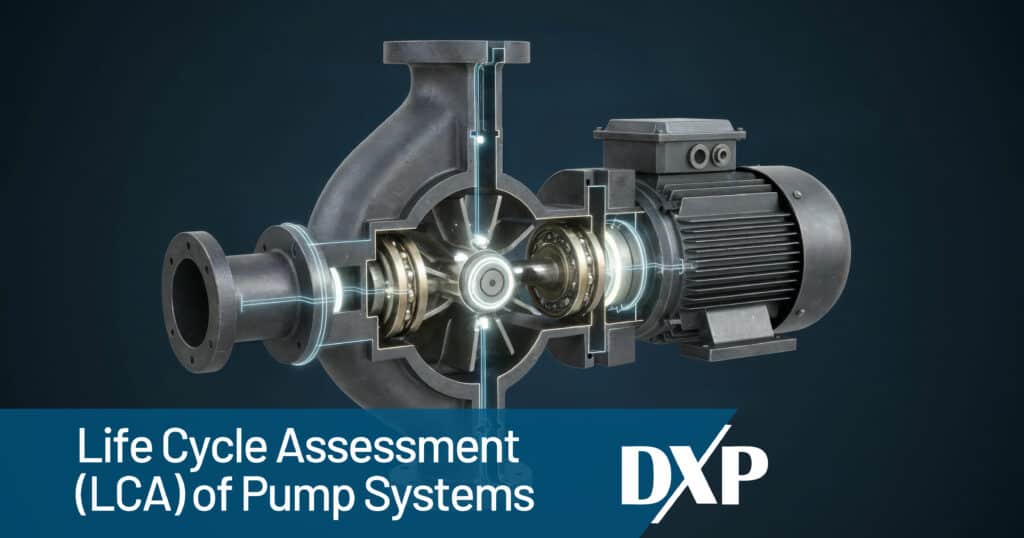
Selecting a pump involves more than comparing upfront purchase prices. The true cost and environmental footprint of a pump extend across its entire operational life—from raw material extraction and manufacturing to daily energy use and end-of-life disposal. Life Cycle Assessment (LCA) is a structured approach that evaluates these impacts over time, offering valuable insight into total cost of ownership and long-term sustainability.
For facilities focused on performance, reliability and responsible resource management, LCA provides a clearer picture of total cost of operation. It affects pump selection, system design and maintenance decisions that influence financial and environmental outcomes.
What LCA Measures
LCA breaks the pump’s life cycle into four major stages:
- Material Extraction & Manufacturing
This phase includes sourcing metals, machining components, assembling the pump and transporting it to the point of installation. While manufacturing impacts are significant, they often represent only a fraction of the pump’s total lifetime footprint. - Installation & Operation
Once in service, the pump begins incurring energy consumption, fluid handling wear and maintenance-related costs. This stage typically represents 80% or more of the total cost and environmental impact over the pump’s life. - Maintenance & Replacement
Efficiency loss, changing operating conditions, seal wear and bearing replacements contribute to ongoing performance adjustments and costs over time. - End-of-Life Recovery or Disposal
This includes refurbishment, recycling of metals, reconditioning of motors or disposal. Pumps made with recyclable materials reduce impact in this final phase.
Why Operational Efficiency Dominates Long-Term Impact
The energy required to run a pump throughout its lifetime is the largest contributor to both operating cost and environmental footprint. Even small decreases in efficiency—caused by improper sizing, pump wear or system friction losses—can result in significant increases in energy consumption.
For example, a pump running continuously at only 5% below peak efficiency could waste thousands of dollars in electricity each year. Over a span of ten to fifteen years, that inefficiency becomes a major cost multiplier.
This is why selecting a pump solely based on purchase price can lead to expensive long-term consequences. The lowest-cost pump may require more frequent maintenance, consume more energy and reach end-of-life sooner than a properly engineered, high-efficiency model.
LCA as a Decision-Making Tool
A well-executed LCA can help organizations:
- Compare pump options based on lifetime cost and emissions—not just purchase price.
- Evaluate how variable speed drives (VFDs), improved sealing systems or different impeller designs affect efficiency.
- Identify opportunities to extend pump service life through optimized maintenance and materials.
- Support sustainability reporting and ESG-driven procurement initiatives.
By quantifying the operational energy footprint, organizations can set performance baselines and measure improvement over time.
How DXP Pacific Supports LCA-Driven Pump Optimization
DXP Pacific works with clients to evaluate pump systems holistically. This includes:
- Reviewing application conditions and duty cycles.
- Assessing pump sizing and system curve alignment.
- Identifying performance drift through vibration and efficiency testing.
- Recommending upgrades such as high-efficiency motors, VFDs or advanced sealing solutions.
- Implementing predictive maintenance to sustain efficiency throughout the pump’s operating life.
We also help evaluate trade-offs between repair and replacement—ensuring the decision aligns with long-term operating cost and sustainability goals.
Building Toward Sustainable Pump Performance
As industries place greater emphasis on environmental responsibility and energy management, Life Cycle Assessment provides a roadmap for making smarter, more informed pump decisions. By looking beyond initial purchase price and considering total life cycle impact, operators can improve performance reliability, reduce operating costs and minimize environmental impact over the system’s full lifespan.
DXP Pacific is ready to help you evaluate and optimize your pump systems through an LCA-based approach that supports both operational excellence and sustainability. Contact us today to get started.